TRX Hover Squat
A unilateral, closed-chain lower-body exercise demanding exceptional stability, strength, and coordination.
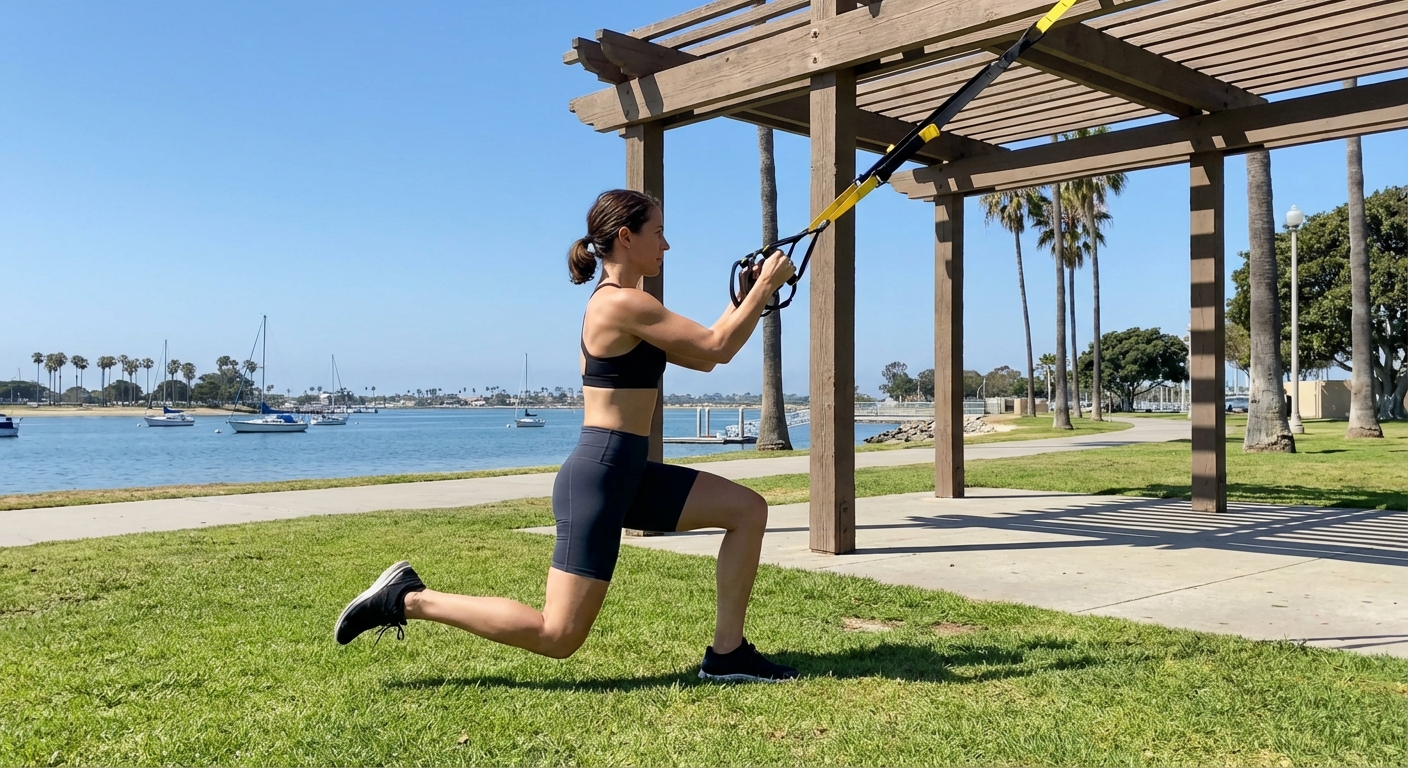
Exercise Overview
The TRX Hover Squat is an advanced unilateral squat variation. The athlete performs a single-leg squat on the planted limb while the contralateral leg is held in a hover position, utilizing the TRX suspension trainer for upper-body support and dynamic balance. This exercise integrates strength, stability, and proprioception under a complex, multi-planar load.
Biomechanics Deep Dive
Kinetic Chain Analysis
This exercise presents a hybrid kinetic chain. The planted leg operates in a closed kinetic chain (CKC), with the foot fixed on the ground. Ground reaction forces (F) travel proximally through the ankle, knee, and hip, requiring concentric, eccentric, and isometric contractions from the quadriceps, hamstrings, and gluteus maximus to control the descent and ascent.
Conversely, the hovering leg and suspended arms operate in an open kinetic chain (OKC). The free leg's position is actively maintained by hip flexors and core stabilizers, while the arms dynamically manage strap tension, creating a reactive environment that challenges the entire system's equilibrium.
Pivot Points & Joint Kinematics
- Hip (Primary Pivot): Undergoes significant flexion (θ ≈ 90°–110°) on the planted side. The external moment arm (distance from hip joint to the line of force of bodyweight) increases as the torso leans forward, demanding greater torque (τ) from the gluteus maximus and hamstrings to extend the hip against gravity.
- Knee (Weight-Bearing Pivot): Flexes to approximately θ ≈ 90°. The patellar tendon moment arm changes throughout the range of motion, creating variable demands on the quadriceps (vastus medialis, lateralis, intermedius, and rectus femoris) to control knee flexion and drive extension.
- Ankle (Dorsiflexion Pivot): The tibia advances over the fixed foot, requiring controlled dorsiflexion. The gastrocnemius and soleus act eccentrically to prevent excessive forward sway and then concentrically to assist in the ascent.
- Upper Body (Dynamic Stabilizers): The elbows dynamically flex (θ ≈ 45°–120°) to manage slack and tension in the suspension straps. This is not a primary strength movement but a critical stabilization task, distributing forces through the latissimus dorsi, rotator cuff, and core.
Stabilization & Force Vectors
The unilateral stance creates a powerful frontal-plane challenge. The body's center of mass must be maintained over the narrow base of support of the single foot.
- Pelvic Stabilization: The gluteus medius and quadratus lumborum on the stance side must generate substantial stabilizing torque (τ) to counteract the adduction moment and prevent pelvic drop on the unsupported, hovering side. Failure here leads to a Trendelenburg sign.
- Core Bracing: The rectus abdominis, obliques, and transverse abdominis maintain isometric tension to create intra-abdominal pressure, stabilizing the spine against rotational and lateral flexion forces.
- Upper-Body Anchoring: The latissimus dorsi engages isometrically to stabilize the torso against the anterior and variable pull vectors of the suspension straps, creating a solid "anchor" from which to perform the lower-body movement.
Muscle Map
Muscles engaged are shown in the diagram above. This is a comprehensive full-body stability exercise with distinct roles for primary movers, secondary movers, and stabilizers.
Primary Movers
The major muscles responsible for producing the squatting motion on the planted leg: Quadriceps (knee extension), Gluteus Maximus (hip extension), and Hamstrings (hip extension & knee stabilization).
Secondary Movers
Muscles that assist the primary movers and control adjacent joints: Gastrocnemius & Soleus (ankle control), Adductors (frontal plane stability), and the Hip Flexors of the hovering leg (to maintain leg position).
Stabilizers
Muscles that work isometrically to maintain posture and joint integrity: Gluteus Medius/Minimus (pelvic stability), Core Complex (spinal stabilization), Latissimus Dorsi (upper-body anchor), and Rotator Cuff (shoulder stability).
Execution Protocol
Step-by-Step Technique
- Setup & Grip: Stand facing the TRX anchor point. Hold the handles with a neutral grip, arms extended forward at chest height. Step back until the straps are taut. Shift your weight entirely onto your left foot.
- Hover Position: Lift your right foot off the ground, flexing the hip and knee to approximately 90°. Actively engage your core and glutes to maintain a level pelvis. This is your starting position.
- Descent (Eccentric Phase): Initiate the movement by hinging at the hips and bending the left knee. Control your descent, keeping the left knee tracking over your second/third toe. Lower until your left thigh is nearly parallel to the floor (or as depth allows with control). Maintain tension in the straps with your arms, keeping your torso upright.
- Bottom Position: Pause briefly at the bottom. Ensure your planted heel remains down, your chest is up, and your hovering leg is held steady without swinging. Do not allow the pelvis to tilt or rotate.
- Ascent (Concentric Phase): Drive through the entire foot of your planted leg, focusing on pressing the ground away. Extend the knee and hip simultaneously, using the glute and quadriceps powerfully. Use the TRX straps for balance only, not to pull yourself up.
- Finish & Reset: Return to the starting hover position with full control. Complete all repetitions on one side before switching to the other leg.
Coach's Note: Master the bodyweight single-leg squat before attempting this loaded or suspended variation. Focus on stability over depth. The goal is a controlled, wobble-free movement.
Common Mistakes & Corrections
| Mistake | Biomechanical Consequence | Correction |
|---|---|---|
| Pelvic Drop (Trendelenburg) | Weak gluteus medius fails to counteract the adduction moment, overloading the lumbar spine and shifting the center of mass. | Consciously "push the standing hip" into abduction. Strengthen gluteus medius with side-lying leg raises and clamshells. |
| Knee Valgus (Collapse Inward) | Increases shear force on the MCL and patellofemoral joint, reducing force production from the quadriceps and glutes. | Actively drive the knee outward over the second/third toe. Use a mirror for feedback. Reduce depth until control is achieved. |
| Excessive Forward Lean | Places disproportionate load on the posterior chain and lower back, while reducing quadriceps engagement. | Maintain a proud chest. Think "sit back" rather than "lean forward." Ensure strap length allows an upright torso. |
| Using Arms to Pull Up | Reduces the neuromuscular demand on the lower body, negating the strength stimulus and compromising core stability. | Use the straps for balance only. Cue "push the ground away" with the planted leg. Practice without straps for body awareness. |
| Hovering Leg Swing | Introduces momentum and rotational forces, destabilizing the pelvis and reducing control over the primary kinetic chain. | Actively engage the hip flexors and core to "lock" the hovering leg in place. Perform the movement slower to eliminate momentum. |
This guide is for educational purposes. Integrate the TRX Hover Squat into your training program progressively, respecting individual mobility and stability thresholds.